
Amazon Policies Impacting High-Value Claims


Amazon's new policies are making it harder for sellers to recover losses on high-value inventory. Here's what changed:
Reimbursement Calculation: As of March 31, 2025, Amazon reimburses sellers based on manufacturing costs, not retail prices. This reduces payouts by 40-80% for high-margin products.
$5,000 Cap: Losses on items valued over $5,000 are capped, leaving sellers to cover the difference unless they have third-party insurance.
60-Day Deadline: Sellers now have only 60 days to file claims, down from 18 months. Missing this window means no reimbursement.
Manual Claims for High-Value Items: Automated reimbursements introduced in late 2024 don’t cover complex or high-value claims, requiring time-consuming manual submissions.
For premium inventory, these changes add financial risk and stricter documentation requirements. Sellers must act quickly, maintain detailed records, and use tools like Refunzo to streamline claims before deadlines.
Key takeaway: If you sell expensive products on Amazon, monitor your account closely, document everything, and file claims promptly to avoid losing money.
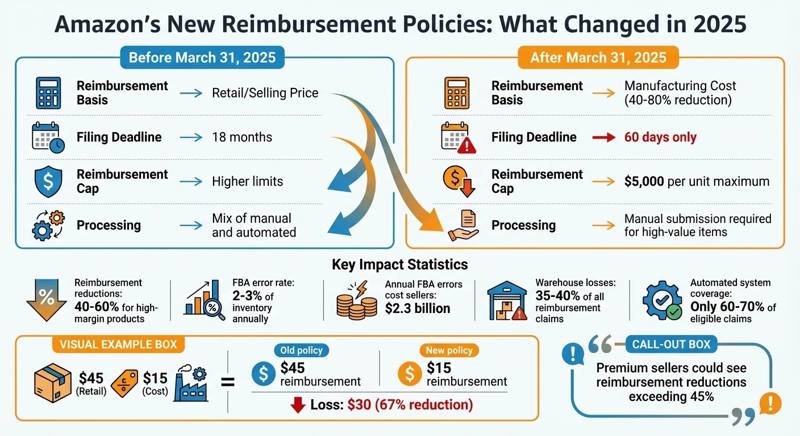
Amazon Reimbursement Policy Changes 2025: Before vs After Comparison
Amazon's Shocking New FBA Inventory Reimbursement Policy | Sellers Are NOT HAPPY

What Qualifies as a High-Value Claim on Amazon?
High-value claims arise when losses involving expensive inventory result in notable financial setbacks. Since March 2025, Amazon's reimbursement model has shifted to base payouts on a product's manufacturing cost instead of its retail price. For example, if a product sells for $45 but costs $15 to manufacture, the reimbursement will now only cover $15. This change has caused a significant drop in recoveries - premium sellers could see reductions exceeding 45%.
Criteria That Define High-Value Claims
Several factors determine whether a claim qualifies as high-value. One major consideration is financial exposure. Claims involving high-cost products carry greater risks, especially with Amazon's $5,000 maximum reimbursement per unit. Sellers with inventory valued close to or above this limit may need to explore third-party insurance to protect their business from substantial losses.
Fulfillment channel differences also influence claim limits. Multi-Channel Fulfillment (MCF) orders, for example, have lower reimbursement caps outside the U.S. While the standard $5,000 limit applies domestically, international shipments face stricter thresholds - such as $400 CAD in Canada, £250 in the UK, and €275 in parts of Europe. For instance, shipping a $600 item to the UK through MCF would only yield a £250 reimbursement, leaving a significant gap.
Profit margins are another critical factor. Industry reports show that 1% to 3% of FBA inventory encounters issues eligible for reimbursement each year. Even small discrepancies in high-value items can lead to considerable revenue losses under the manufacturing cost-based model.
Typical Situations That Generate High-Value Claims
Several scenarios illustrate the challenges of high-value claims. Inbound shipment discrepancies are a common issue. These occur when Amazon receives fewer units than shipped or miscounts inventory during processing. With an error rate of 2% to 3%, a shipment of 100 high-value units could result in two or three missing items, requiring sellers to file claims with detailed documentation within a 60-day deadline.
Warehouse losses are another frequent problem, accounting for around 35% to 40% of reimbursement claims. These losses happen during internal transfers or storage. While Amazon introduced an automated reimbursement system in late 2024 to handle straightforward cases, more complex discrepancies - like missing high-value units during transfers - still require manual claims. Unfortunately, such claims often fail to recover the full cost of the lost inventory.
Lastly, issues with removal orders also generate high-value claims. Lost or damaged removal orders must be filed within 15 to 75 days, but reimbursements often fall short of covering actual product costs. Similarly, products damaged during removal or returned in unsellable condition are eligible for claims. However, customer return discrepancies are reimbursed based on the selling price (minus fees), not the manufacturing cost, further complicating recovery efforts.
Amazon Reimbursement Policies for High-Value Claims in 2026
Amazon has updated its reimbursement policies, which significantly impact how sellers recover losses for high-value inventory. If you're dealing with expensive products, understanding these changes is essential to safeguard your earnings.
60-Day Filing Deadline
Sellers now have a strict 60-day window to file claims for lost or damaged inventory. This short timeline means you need to keep a close eye on your account activity. Missing the deadline? You lose your chance for reimbursement, no matter how valuable the item. To stay prepared, maintain a digital archive of timestamped invoices, packing slips, and photos of your high-value products. These documents will be crucial if you need to file a claim.
Manufacturing Cost-Based Reimbursements
As of March 31, 2025, Amazon calculates reimbursements based on manufacturing or sourcing costs, not the selling price. While this aligns with practices in logistics and insurance industries, it can significantly reduce payouts for sellers with high-margin products.
"This fundamental shift means sellers could see reimbursement values drop by 40-60% compared to previous years." – GoWrath
This change has also raised concerns among sellers about sharing sensitive cost data with Amazon. Many worry that this information could be used to develop competing private-label products. However, Amazon insists that such data is necessary for processing reimbursements accurately.
Manual Submission Required for High-Value Claims
Although Amazon introduced an automated "proactive reimbursement" system in late 2024 for common warehouse losses, high-value claims still require manual submission. The automated system doesn't handle complex cases, such as discrepancies involving expensive inventory or unusual scenarios.
To file these claims, sellers need to use the Inventory Defect and Reimbursement (IDR) portal in Seller Central. This process can be time-consuming, often requiring detailed documentation and back-and-forth communication with Amazon's support team. With FBA errors costing sellers an estimated $2.3 billion annually, and an average error rate of 2% to 3%, even small mistakes can lead to significant financial losses - especially for high-value products. Up next, find out how to navigate the filing process and track your claims effectively.
How to File and Track High-Value Claims
Filing high-value claims through Amazon Seller Central requires careful attention to detail and thorough documentation. Unlike standard claims, the process for expensive inventory is entirely manual, so you'll need to navigate it step by step.
Documentation Needed for Claims
Start by gathering all the required documents. Amazon mandates invoices or purchase receipts that match the exact business name registered on your Amazon account. Since March 31, 2025, these need to reflect your manufacturing or sourcing costs instead of retail prices. For items valued over $100, provide clear, multi-angle photos. Beginning in 2026, Amazon also requires video evidence of your packing process and unboxing of returns to resolve disputes effectively.
Other essential records include:
Your Inventory Adjustments Report (look for "M" to identify missing items).
Shipment records with tracking details.
FNSKU CSV files for damaged goods.
Serial number tracking for returns.
Photos of return packages upon arrival.
Additionally, maintain detailed communication logs to back up your claim. Once your documentation is organized, submit your claim through Seller Central.
Submitting Claims Through Seller Central
Navigate to the appropriate section in Seller Central to file your claim. For customer disputes, use the A-to-z Guarantee. For inventory discrepancies, go to Reports > Fulfillment > Reimbursements. If you're dealing with multiple damaged items, photograph each one individually and refine your Inventory Adjustments Report by FNSKU to include only relevant entries.
In cases involving damaged returns or suspected fraud - like receiving a rock instead of your product - file a SAFE-T claim with supporting photo and video evidence. Amazon typically processes reimbursements within 45 days, but more complex cases may take longer.
Tracking Claim Status and Responding to Amazon
You can track your claims in Seller Central under Reports > Payments > Transaction View or Reports > Fulfillment > Reimbursements. For A-to-z claims, check Performance > A-to-z Guarantee Claims. Keep in mind, there’s a strict 60-day deadline for filing claims, so act quickly.
If Amazon requests more information, respond within 48 hours to avoid the claim being automatically granted to the buyer. If your claim is denied, you have 30 days to file an appeal. For high-value claims that face repeated denials, consider requesting a phone call from the Captive team, a specialized group with greater authority to handle complex issues.
"A seller should not go to the mat with executives for a $5 reimbursement... But a $500 reimbursement? Or a $10,000 reimbursement? Depending upon the size of the seller, these are completely reasonable to pursue." – Riverbend Consulting
When escalating claims, keep your emails concise, factual, and professional. Never alter invoices or shipping documents, as doing so can lead to account suspension. Consistently monitor your claim status to ensure timely responses and follow-ups.
Using Refunzo to Improve High-Value Claim Recovery
Handling high-value claims manually can be overwhelming, even for experienced sellers. Refunzo simplifies this process by automating reconciliation, continuously scanning your account for discrepancies before the critical 60-day deadline. Its thorough 21-point reconciliation system pinpoints issues in four key areas: shipments (like stock mismatches or damaged inbound units), inventory (lost or misplaced items in fulfillment centers), payments (fee errors due to incorrect weight or dimensions), and returns (refunds issued without corresponding item returns).
21-Point Reconciliation Checks for High-Value Discrepancies
Refunzo’s system is designed to catch high-value discrepancies that often go unnoticed. It monitors your account in real time, identifying issues such as stock deductions after shipment closure, damaged goods during warehouse transfers, duplicate storage fees, and refunds issued without returned items. Each issue is broken down by SKU, complete with estimated dollar values. The platform also flags "urgent claims" nearing the 60-day deadline, ensuring you act in time to recover your losses.
Policy-Compliant Reports and Documentation
Refunzo generates reports that comply with Amazon's latest policies, including the shift to manufacturing cost-based reimbursements. For every discrepancy, the platform prepares all necessary documentation, such as evidence for lost units, damaged goods, or fee overcharges. These reports include real-time refund estimates and detailed breakdowns by category and issue type. By linking your Seller Central account, you can scan the past 60 days for discrepancies and use the "Urgent Claims" report to prioritize high-value recoveries. Additionally, Refunzo provides Inventory Adjustment and Fee Details reports to streamline monthly financial reviews for your team.
Claim Filing Service with Capped Commission
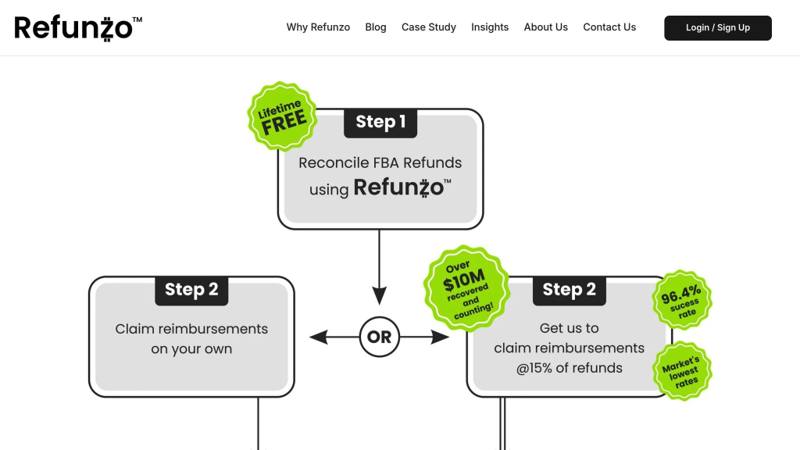
Refunzo offers two flexible options: use the free reconciliation service to identify discrepancies and file claims on your own, or take advantage of their claim filing service. With the latter, Refunzo handles everything - from creating cases to submitting evidence and following up with Amazon - for a 15% commission on the refund amount, capped at $5,000. You only pay after the reimbursement is credited to your account, eliminating upfront costs and financial risks. This capped commission ensures that even for the largest claims, your fees remain manageable.
Conclusion
Amazon's shift to manufacturing cost-based reimbursements has reshaped how sellers recover high-value claims. Now, reimbursements are often limited to manufacturing costs - typically 60–80% lower than retail value - along with a strict $5,000 cap per unit. This makes accurate documentation and timely claim submission more crucial than ever.
With a tight 60-day deadline and Amazon's automated system covering only part of the claims, sellers must stay vigilant. As Titan Network explains:
"Amazon's automatic reimbursement system only catches about 60–70% of eligible claims. The rest? You have to hunt them down yourself."
This means sellers need to keep detailed cost records and manually submit claims to recover every eligible reimbursement. Missing or incomplete documentation can lead to lower estimates, especially for high-value claims. Essential evidence like supplier invoices, bills of materials, and shipping proofs by ASIN is often required. Proactively entering accurate cost data into the "Manage Your Sourcing Cost" portal can also prevent disputes later on.
To simplify this process, tools like Refunzo can make a big difference. Refunzo automates reconciliation with 21-point checks across shipments, inventory, payments, and returns. It flags urgent claims approaching the 60-day deadline, generates policy-compliant reports with manufacturing cost data, and even files claims on your behalf for a capped 15% commission (up to $5,000). Plus, there's no upfront cost - you only pay after receiving credits.
Navigating Amazon's policies and recovering losses takes effort, whether through manual tracking or automation. By combining thorough documentation with smart tools, sellers can protect their profits and ensure no reimbursement opportunity is missed.
FAQs
Which Amazon claim types still reimburse at selling price?
Amazon currently reimburses sellers at the selling price for claims related to lost or damaged FBA inventory. However, starting March 31, 2025, this policy will change. Reimbursements will instead be based on the manufacturing cost of the inventory. This shift will directly affect how sellers recover funds for inventory issues. Staying updated on these policy changes is essential for planning and managing your business effectively.
What’s the fastest way to catch claim issues before 60 days?
Performing a weekly review of your inventory reports is the quickest way to stay on top of things. Regular checks make it easier to catch discrepancies early, allowing you to file claims within Amazon's strict 60-day deadline. This proactive approach minimizes the chance of missing important deadlines and ensures you have enough time to collect the necessary documentation to secure reimbursements without delay.
How should I document manufacturing cost for reimbursements?
To claim reimbursements for manufacturing costs, Amazon expects you to provide detailed documentation. This includes records like supplier invoices, labor charges, and shipping fees related to manufacturing. However, you should exclude shipping, customs duties, and packaging costs, as these are not considered part of the manufacturing expenses.
Make use of Amazon’s Inventory Defect and Reimbursement portal to handle these claims efficiently and ensure compliance with their policies. Staying organized is key - maintain clear records such as invoices and detailed cost breakdowns to support your claims under Amazon’s updated guidelines.