
Why Documentation Matters for Amazon Cost-Based FBA Reimbursements in 2026
Dec 16, 2025
Dec 16, 2025
TL;DR
Amazon reimbursement claims in 2026 are decided by sourcing cost, not selling price, especially for inventory lost or damaged before a customer order.
Under the Amazon reimbursement policy 2025, clean invoices and clear cost documentation now determine whether a claim is approved, reduced, or denied.
Many valid claims fail due to missing, unclear, or mismatched invoices rather than actual inventory loss.
Common seller mistakes like using screenshots, wrong invoices, or outdated costs quietly reduce payouts.
Sellers who organise cost records, align invoices with ASINs, and track landed costs recover more FBA reimbursements consistently.
You filed an Amazon reimbursement claim, everything looked correct, yet the payout was lower than expected, or the claim was denied altogether. If this feels familiar, you are not alone. In 2026, many sellers are discovering that Amazon FBA reimbursement claims are no longer judged the way they used to be. The loss might be real, but Amazon now cares less about what you sold the product for and far more about what it actually cost you.
This shift has caught sellers off guard. Reimbursement claims that would have been approved earlier are now rejected simply because invoices, sourcing costs, or supplier details are missing or unclear. For busy sellers, this feels frustrating and confusing, especially when there is no clear explanation from Amazon.
The reality is simple. Amazon’s reimbursement system has moved to a cost-based model, and documentation now decides outcomes. In this blog, we break down why claims fail, what Amazon really checks, and how sellers can protect Amazon reimbursements without wasting time or money.
Why do Amazon reimbursement claims get rejected?
Many sellers are seeing FBA seller reimbursement claims rejected or approved for much lower amounts, not because Amazon made a mistake, but because the rules have changed, and expectations have not. When Amazon announced its cost-based reimbursement update to the FBA inventory policy, the shift was clear.
For inventory lost or damaged before a customer places an order, Amazon now reimburses based on sourcing cost, not the selling price. This brings Amazon in line with how most logistics and fulfillment providers operate.
The reasoning is practical. Amazon is working to reduce defects across its fulfillment network, and at the same time, more seller inventory is moving through Amazon’s supply chain for multiple channels. A standard, cost-based approach keeps reimbursements consistent.
Here is where reimbursement claims get rejected. Sellers submit requests assuming Amazon will reimburse the retail price, but fail to provide clean invoices, landed cost details, or supplier documentation. When cost data is missing or unclear, Amazon defaults to lower estimates or denies the claim. The key detail many sellers miss is this. If an item is lost after a customer order, Amazon still reimburses the sales price minus fees. Before an order, documentation decides everything.
What Amazon really checks before approving a FBA reimbursement
When a reimbursement claim is submitted, Amazon is no longer just checking whether inventory was lost or damaged. It is checking whether your cost data supports the claim. Behind the scenes, Amazon applies cost-based logic.
For items affected before a customer order, the system looks for sourcing cost signals, invoices, unit price, quantities, and supplier details to track Amazon reimbursement claims accurately. If this data lines up, the claim moves forward. If it does not, payouts are reduced or denied.
This is why Amazon now asks for invoices far more often than before. Amazon needs proof of what the product actually costs you, not what you hoped to earn from it. Clean, itemized invoices help Amazon validate that number quickly.
When cost data is unclear or missing, Amazon does not pause to investigate. It defaults to estimated values or rejects the claim outright. For sellers, this means documentation is no longer a backup. It is the deciding factor in whether a reimbursement gets approved.
How do paperwork errors cause valid Amazon reimbursement claims to fail?
Many reimbursement claims fail today, even when the loss is real and fully valid. The issue is no longer whether Amazon lost or damaged the inventory. It is whether the paperwork clearly proves what that inventory actually costs.
Sellers now face a choice during claims. Accept Amazon’s estimated sourcing cost or submit their own. On paper, Amazon’s estimate seems convenient, but it often relies on comparable products across marketplaces and wholesale channels. That approach misses category-specific costs like packaging, compliance, or smaller production runs.
This is why sellers with genuine losses still see claims approved for lower amounts or rejected altogether. Internal analysis shows that automated cost estimates can undervalue real sourcing costs by 15 to 25%. When documentation is missing, incomplete, or poorly matched to the ASIN, Amazon defaults to those lower estimates.
In today’s system, documentation quality decides outcomes. Sellers who provide clean, item-level sourcing data consistently recover more. Those who rely on estimates leave money on the table, even when the claim itself is valid.
How are invoices essential for claim approval?
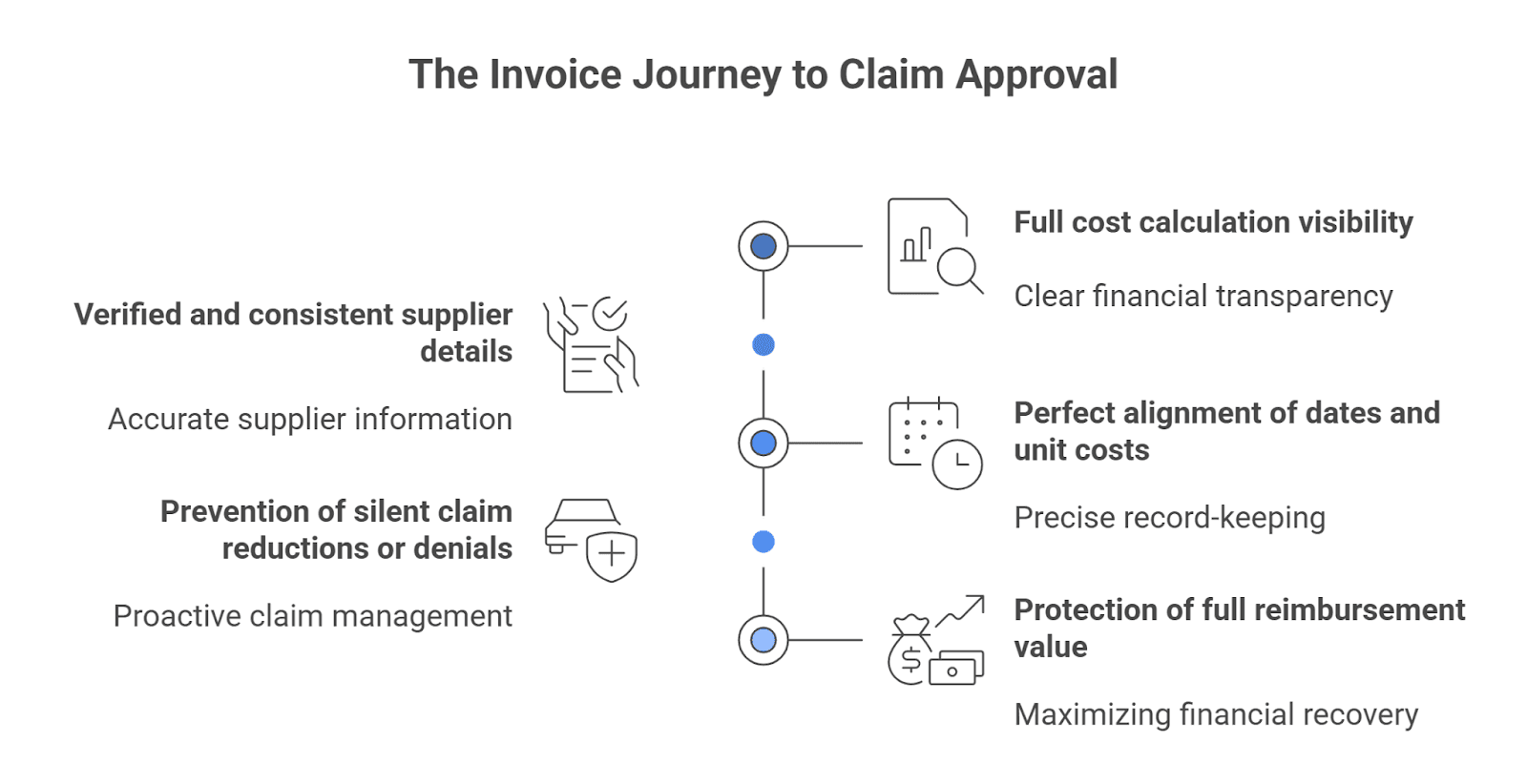
1. Amazon expects invoices to tell the full cost calculation
Invoices must clearly show the supplier name, purchase date, item description, quantity, and per-unit cost. If Amazon cannot match the invoice to the ASIN without guessing, the claim is weakened from the start.
2. Supplier details now carry more weight than before
Amazon checks whether the supplier looks legitimate and consistent. Missing addresses, vague business names, or reused invoices raise red flags and slow approvals.
3. Dates and unit costs must align perfectly
Invoice dates need to match the inventory shipment period. Unit costs must be easy to calculate. If Amazon has to do the math, it often defaults to lower estimates.
4. Weak invoices fail quietly
Poor-quality invoices rarely trigger clear rejection messages. Claims simply get approved for less or denied without explanation.
5. Clean invoices protect payout value
Clear, item-level invoices give Amazon no reason to downgrade your reimbursement. In today’s system, paperwork is not supported; it is the decision.
The most common seller mistakes kill reimbursements for documentation
Submit the wrong invoice for the wrong shipment: Amazon checks invoice dates, quantities, and shipment timelines closely. If the invoice does not clearly match the FBA shipment where the loss occurred, the claim weakens immediately.
Use screenshots instead of proper documents: Screenshots, cropped images, or payment confirmations are no longer enough. Amazon expects formal invoices with clear supplier and item details. Screenshots look incomplete and often get ignored.
Mismatch between ASIN cost and submitted proof: When the unit cost on the invoice does not clearly map to the ASIN in the claim, Amazon defaults to its own estimates. This is one of the fastest ways payouts get reduced.
Misslanded cost components: Packaging, labelling, or compliance-related costs are often excluded, even though they affect the true sourcing cost. Amazon only considers what is documented.
Assume “this worked before” still applies: Amazon’s reimbursement logic has changed. Old claim habits no longer align with current checks, and relying on them quietly costs sellers money today.
How Refunzo fits into the new reimbursement claim process
The biggest shift in FBA reimbursements is not just lower payouts, but wasted effort. Sellers are still filing reimbursements that were never going to be approved under the new cost-based rules. That is where Refunzo changes the workflow.
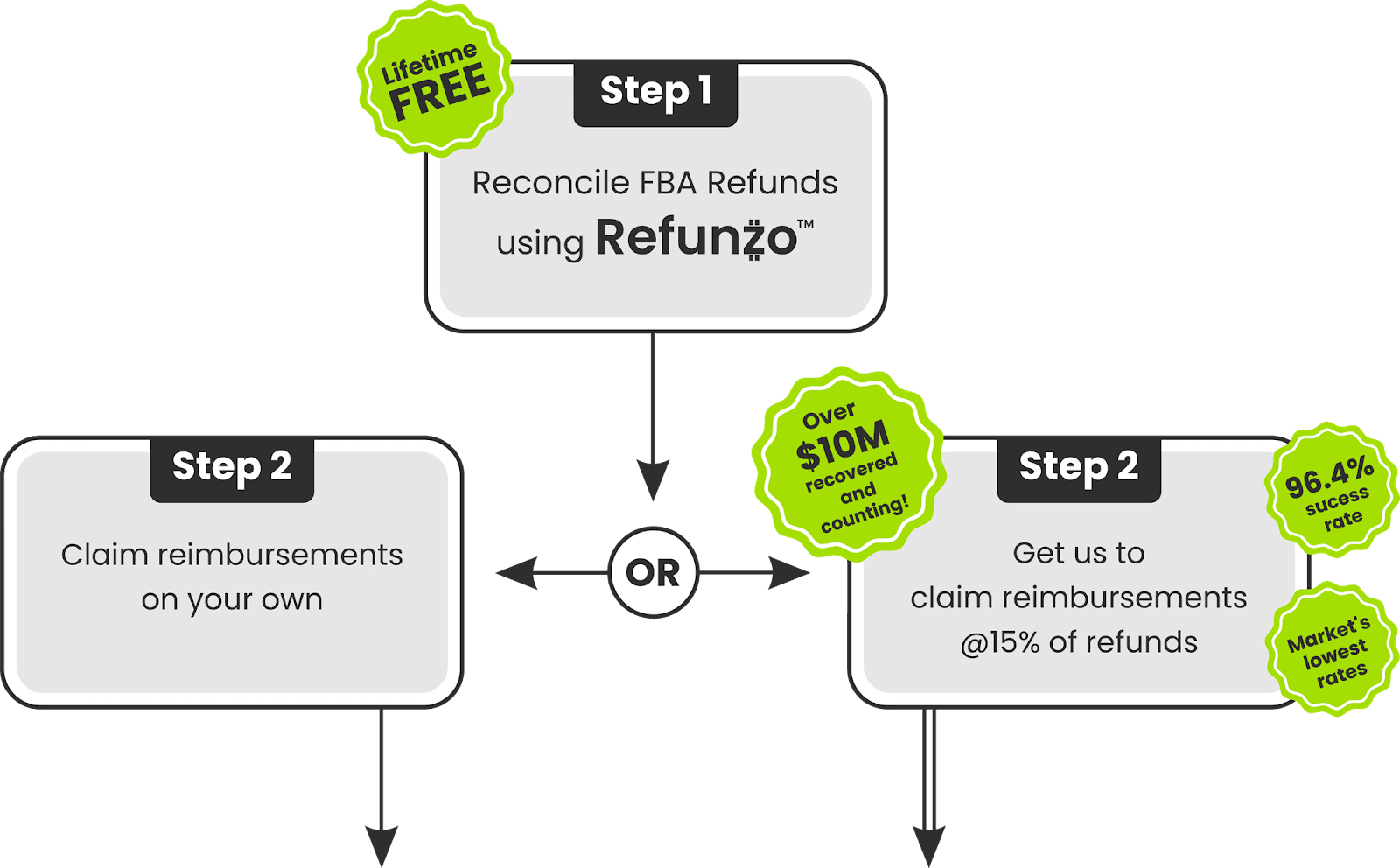
Sellers can automate FBA reimbursement using Refunzo, which simplifies the reimbursement process by starting with clarity, not claims. Once you connect your Amazon account to the Refunzo web app, it runs a deep reconciliation across more than 20 critical checkpoints.
These checks cover lost, damaged, missing, and incorrectly reimbursed inventory, giving sellers a clear picture of where money is actually owed. You receive a detailed reconciliation report that highlights eligible cases along with an estimated recovery amount.
From there, sellers can choose how hands-on they want to be. You can create support cases yourself using the insights provided, or opt to let Refunzo handle the entire claiming process. If you choose the managed option, the refund manager authenticates your account securely, logs support cases, substantiates each claim with the right data, and follows up meticulously.
There are no upfront charges, and any approved reimbursements are credited directly to your bank account. The result is a structured, low-effort workflow that focuses only on recoverable claims, not wasted follow-ups.
What sellers should change in 2026 to fix the Amazon reimbursement process
1. Get your cost records in order
Every unit sent to Amazon should be supported by clear sourcing documents, invoices, supplier price sheets, and landed cost details. When Amazon asks for proof, fast and accurate documentation matters far more than lengthy explanations.
2. Keep your costs updated in Seller Central
Supplier pricing, shipping costs, and currency rates change often. If your costs are outdated, your reimbursements will be too. Regular updates help ensure approved claims reflect your real expenses.
3. Reduce reliance on a single fulfillment partner
With Amazon reimbursements now tied strictly to cost, keeping all inventory in one place increases financial risk. Spreading inventory can help limit the impact if losses or damage rise at a specific location.
4. Use reimbursement data as an improvement signal
Patterns in FBA lost or damaged inventory usually point to packaging or prep issues. Adjusting these early helps reduce repeat problems and saves money before future claims arise.
Final words
Amazon reimbursements in 2026 are no longer about who files the most claims. They are about who can clearly prove their costs. Under the Amazon reimbursement policy changes 2025, many sellers are now seeing real inventory losses turn into lower payouts or denied claims, simply because documentation does not meet the new expectations.
The good news is that this system rewards clarity and preparation. Clean invoices, aligned ASIN-level costs, and accurate landed cost records consistently lead to better outcomes. Sellers who organize their data, understand what Amazon checks, and avoid outdated claim habits recover more without unnecessary effort.
The smartest change sellers can make in 2026 is simple: stop filing claims blindly and start managing reimbursements as a process. With the right documentation, clear cost tracking, and Amazon reimbursement tools like Refunzo to filter and validate claims, reimbursements become predictable instead of frustrating.
TL;DR
Amazon reimbursement claims in 2026 are decided by sourcing cost, not selling price, especially for inventory lost or damaged before a customer order.
Under the Amazon reimbursement policy 2025, clean invoices and clear cost documentation now determine whether a claim is approved, reduced, or denied.
Many valid claims fail due to missing, unclear, or mismatched invoices rather than actual inventory loss.
Common seller mistakes like using screenshots, wrong invoices, or outdated costs quietly reduce payouts.
Sellers who organise cost records, align invoices with ASINs, and track landed costs recover more FBA reimbursements consistently.
You filed an Amazon reimbursement claim, everything looked correct, yet the payout was lower than expected, or the claim was denied altogether. If this feels familiar, you are not alone. In 2026, many sellers are discovering that Amazon FBA reimbursement claims are no longer judged the way they used to be. The loss might be real, but Amazon now cares less about what you sold the product for and far more about what it actually cost you.
This shift has caught sellers off guard. Reimbursement claims that would have been approved earlier are now rejected simply because invoices, sourcing costs, or supplier details are missing or unclear. For busy sellers, this feels frustrating and confusing, especially when there is no clear explanation from Amazon.
The reality is simple. Amazon’s reimbursement system has moved to a cost-based model, and documentation now decides outcomes. In this blog, we break down why claims fail, what Amazon really checks, and how sellers can protect Amazon reimbursements without wasting time or money.
Why do Amazon reimbursement claims get rejected?
Many sellers are seeing FBA seller reimbursement claims rejected or approved for much lower amounts, not because Amazon made a mistake, but because the rules have changed, and expectations have not. When Amazon announced its cost-based reimbursement update to the FBA inventory policy, the shift was clear.
For inventory lost or damaged before a customer places an order, Amazon now reimburses based on sourcing cost, not the selling price. This brings Amazon in line with how most logistics and fulfillment providers operate.
The reasoning is practical. Amazon is working to reduce defects across its fulfillment network, and at the same time, more seller inventory is moving through Amazon’s supply chain for multiple channels. A standard, cost-based approach keeps reimbursements consistent.
Here is where reimbursement claims get rejected. Sellers submit requests assuming Amazon will reimburse the retail price, but fail to provide clean invoices, landed cost details, or supplier documentation. When cost data is missing or unclear, Amazon defaults to lower estimates or denies the claim. The key detail many sellers miss is this. If an item is lost after a customer order, Amazon still reimburses the sales price minus fees. Before an order, documentation decides everything.
What Amazon really checks before approving a FBA reimbursement
When a reimbursement claim is submitted, Amazon is no longer just checking whether inventory was lost or damaged. It is checking whether your cost data supports the claim. Behind the scenes, Amazon applies cost-based logic.
For items affected before a customer order, the system looks for sourcing cost signals, invoices, unit price, quantities, and supplier details to track Amazon reimbursement claims accurately. If this data lines up, the claim moves forward. If it does not, payouts are reduced or denied.
This is why Amazon now asks for invoices far more often than before. Amazon needs proof of what the product actually costs you, not what you hoped to earn from it. Clean, itemized invoices help Amazon validate that number quickly.
When cost data is unclear or missing, Amazon does not pause to investigate. It defaults to estimated values or rejects the claim outright. For sellers, this means documentation is no longer a backup. It is the deciding factor in whether a reimbursement gets approved.
How do paperwork errors cause valid Amazon reimbursement claims to fail?
Many reimbursement claims fail today, even when the loss is real and fully valid. The issue is no longer whether Amazon lost or damaged the inventory. It is whether the paperwork clearly proves what that inventory actually costs.
Sellers now face a choice during claims. Accept Amazon’s estimated sourcing cost or submit their own. On paper, Amazon’s estimate seems convenient, but it often relies on comparable products across marketplaces and wholesale channels. That approach misses category-specific costs like packaging, compliance, or smaller production runs.
This is why sellers with genuine losses still see claims approved for lower amounts or rejected altogether. Internal analysis shows that automated cost estimates can undervalue real sourcing costs by 15 to 25%. When documentation is missing, incomplete, or poorly matched to the ASIN, Amazon defaults to those lower estimates.
In today’s system, documentation quality decides outcomes. Sellers who provide clean, item-level sourcing data consistently recover more. Those who rely on estimates leave money on the table, even when the claim itself is valid.
How are invoices essential for claim approval?
1. Amazon expects invoices to tell the full cost calculation
Invoices must clearly show the supplier name, purchase date, item description, quantity, and per-unit cost. If Amazon cannot match the invoice to the ASIN without guessing, the claim is weakened from the start.
2. Supplier details now carry more weight than before
Amazon checks whether the supplier looks legitimate and consistent. Missing addresses, vague business names, or reused invoices raise red flags and slow approvals.
3. Dates and unit costs must align perfectly
Invoice dates need to match the inventory shipment period. Unit costs must be easy to calculate. If Amazon has to do the math, it often defaults to lower estimates.
4. Weak invoices fail quietly
Poor-quality invoices rarely trigger clear rejection messages. Claims simply get approved for less or denied without explanation.
5. Clean invoices protect payout value
Clear, item-level invoices give Amazon no reason to downgrade your reimbursement. In today’s system, paperwork is not supported; it is the decision.
The most common seller mistakes kill reimbursements for documentation
Submit the wrong invoice for the wrong shipment: Amazon checks invoice dates, quantities, and shipment timelines closely. If the invoice does not clearly match the FBA shipment where the loss occurred, the claim weakens immediately.
Use screenshots instead of proper documents: Screenshots, cropped images, or payment confirmations are no longer enough. Amazon expects formal invoices with clear supplier and item details. Screenshots look incomplete and often get ignored.
Mismatch between ASIN cost and submitted proof: When the unit cost on the invoice does not clearly map to the ASIN in the claim, Amazon defaults to its own estimates. This is one of the fastest ways payouts get reduced.
Misslanded cost components: Packaging, labelling, or compliance-related costs are often excluded, even though they affect the true sourcing cost. Amazon only considers what is documented.
Assume “this worked before” still applies: Amazon’s reimbursement logic has changed. Old claim habits no longer align with current checks, and relying on them quietly costs sellers money today.
How Refunzo fits into the new reimbursement claim process
The biggest shift in FBA reimbursements is not just lower payouts, but wasted effort. Sellers are still filing reimbursements that were never going to be approved under the new cost-based rules. That is where Refunzo changes the workflow.
Sellers can automate FBA reimbursement using Refunzo, which simplifies the reimbursement process by starting with clarity, not claims. Once you connect your Amazon account to the Refunzo web app, it runs a deep reconciliation across more than 20 critical checkpoints.
These checks cover lost, damaged, missing, and incorrectly reimbursed inventory, giving sellers a clear picture of where money is actually owed. You receive a detailed reconciliation report that highlights eligible cases along with an estimated recovery amount.
From there, sellers can choose how hands-on they want to be. You can create support cases yourself using the insights provided, or opt to let Refunzo handle the entire claiming process. If you choose the managed option, the refund manager authenticates your account securely, logs support cases, substantiates each claim with the right data, and follows up meticulously.
There are no upfront charges, and any approved reimbursements are credited directly to your bank account. The result is a structured, low-effort workflow that focuses only on recoverable claims, not wasted follow-ups.
What sellers should change in 2026 to fix the Amazon reimbursement process
1. Get your cost records in order
Every unit sent to Amazon should be supported by clear sourcing documents, invoices, supplier price sheets, and landed cost details. When Amazon asks for proof, fast and accurate documentation matters far more than lengthy explanations.
2. Keep your costs updated in Seller Central
Supplier pricing, shipping costs, and currency rates change often. If your costs are outdated, your reimbursements will be too. Regular updates help ensure approved claims reflect your real expenses.
3. Reduce reliance on a single fulfillment partner
With Amazon reimbursements now tied strictly to cost, keeping all inventory in one place increases financial risk. Spreading inventory can help limit the impact if losses or damage rise at a specific location.
4. Use reimbursement data as an improvement signal
Patterns in FBA lost or damaged inventory usually point to packaging or prep issues. Adjusting these early helps reduce repeat problems and saves money before future claims arise.
Final words
Amazon reimbursements in 2026 are no longer about who files the most claims. They are about who can clearly prove their costs. Under the Amazon reimbursement policy changes 2025, many sellers are now seeing real inventory losses turn into lower payouts or denied claims, simply because documentation does not meet the new expectations.
The good news is that this system rewards clarity and preparation. Clean invoices, aligned ASIN-level costs, and accurate landed cost records consistently lead to better outcomes. Sellers who organize their data, understand what Amazon checks, and avoid outdated claim habits recover more without unnecessary effort.
The smartest change sellers can make in 2026 is simple: stop filing claims blindly and start managing reimbursements as a process. With the right documentation, clear cost tracking, and Amazon reimbursement tools like Refunzo to filter and validate claims, reimbursements become predictable instead of frustrating.
Related post

FBA Reimbursement
Multi-marketplace reconciliation is broken? How Refunzo helps global Amazon sellers get their money back
Multi-marketplace reconciliation is broken? How Refunzo helps global Amazon sellers get their money back
Multi-marketplace reconciliation is broken? How Refunzo helps global Amazon sellers get their money back
Multi-marketplace reconciliation is broken? How Refunzo helps global Amazon sellers get their money back
Mar 25, 2026
|
12 mins
Amazon FBA Reimbursements
Stop revenue loss: Handle Amazon reversed reimbursement like a pro
Stop revenue loss: Handle Amazon reversed reimbursement like a pro
Stop revenue loss: Handle Amazon reversed reimbursement like a pro
Stop revenue loss: Handle Amazon reversed reimbursement like a pro
Mar 7, 2026
|
12mins
Amazon FBA Reimbursements
Amazon reimbursement report every seller must check to claim missing reimbursements
Amazon reimbursement report every seller must check to claim missing reimbursements
Amazon reimbursement report every seller must check to claim missing reimbursements
Amazon reimbursement report every seller must check to claim missing reimbursements
Mar 2, 2026
|
12 mins

Stay updated by subscribing
to our newsletter.
Stay updated by subscribing
to our newsletter.
Stay informed and up-to-date with the latest news and updates
from our company by subscribing to our newsletter.
Stay informed and up-to-date
with the latest news and updates
from our company by subscribing to
our newsletter.